

In our first episode back, we dive deep into the origins of Black History Month—long before it was officially recognized—and into the people who fought to ensure Black history was preserved, taught, and honored.
You cannot tell the history of Chicago without telling the history of Black Chicago. And you cannot tell the history of the United States without the history of Black America.
In our first episode back, we dive deep into the origins of Black History Month—long before it was officially recognized—and into the people who fought to ensure Black history was preserved, taught, and honored.
What began in community halls and back rooms was decades in the making. In 1926, what we now know as Black History Month was first observed as Negro History Week, but its foundation was laid years earlier by historian Dr. Carter G. Woodson, often called the “Father of Black History.”
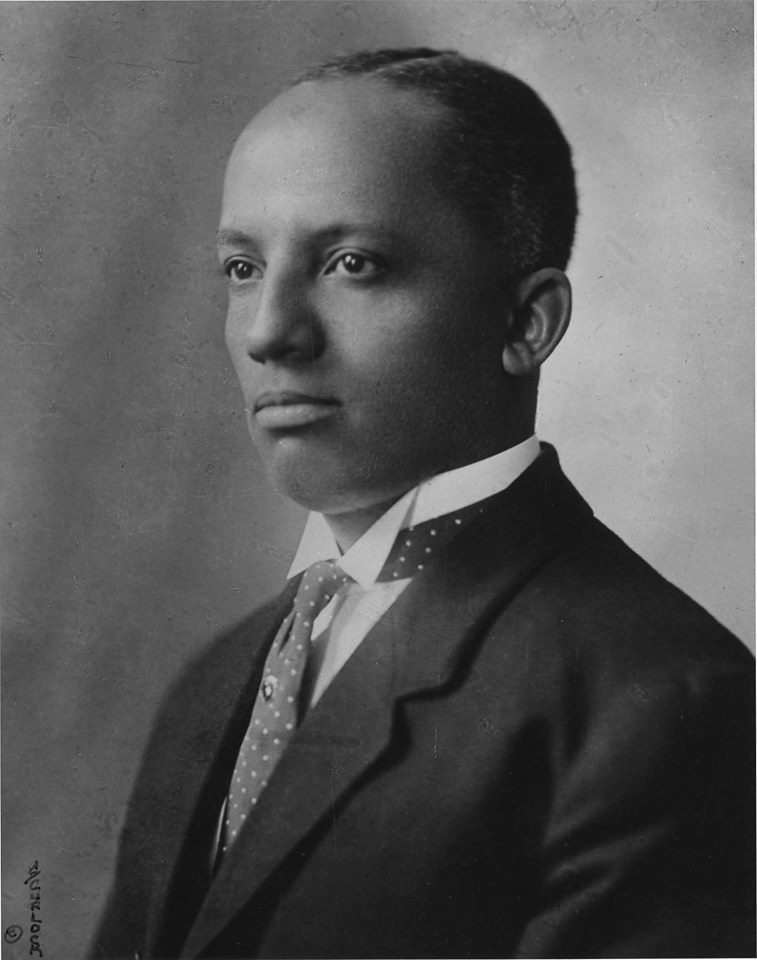
Born in 1875 to formerly enslaved parents, Woodson understood firsthand the power of education as a tool for liberation. He worked as a sharecropper and miner in his youth, entered high school late, and still graduated in under two years. His academic journey took him from Berea College to the University of Chicago—where he earned a second bachelor’s degree and a master’s in European history—and eventually to Harvard University, where he became only the second Black American (after W.E.B. Du Bois) to earn a PhD, and the first child of formerly enslaved parents to receive a doctorate in history.
In 1915, Woodson attended the 50th anniversary of emancipation in Washington, D.C.—an event that profoundly shaped his life’s work. That same year, he helped found the Association for the Study of Negro Life and History (ASALH) to address the exclusion and misrepresentation of Black contributions in traditional education. Through ASALH, Woodson launched The Journal of Negro History (1916), Negro History and Literature Week (1924), and ultimately Negro History Week in 1926. His vision emphasized rigorous scholarship, meaningful education, and community engagement—not surface-level celebration.
Over time, Negro History Week gained national recognition, eventually expanding into Black History Month in 1970 through the leadership of Black educators and students at Kent State University. In 1976, President Gerald Ford formally recognized Black History Month at the federal level. Today, it continues to fulfill Woodson’s mission: education as empowerment.
But Chicago’s role in this history runs even deeper.
As we researched this episode, we encountered a powerful idea: Did the reason for Negro History Week need to be recorded? Just as libraries are more than places to borrow books, librarians can be historians—and history itself can be an act of resistance.
Enter Vivian G. Harsh.
Harsh was a librarian, historian, and cultural architect who quietly shaped Black intellectual life on Chicago’s South Side. In 1932, she became the Chicago Public Library’s first Black branch head at the George Cleveland Hall Branch in Bronzeville—at a time when Black neighborhoods had been systematically denied access to libraries.
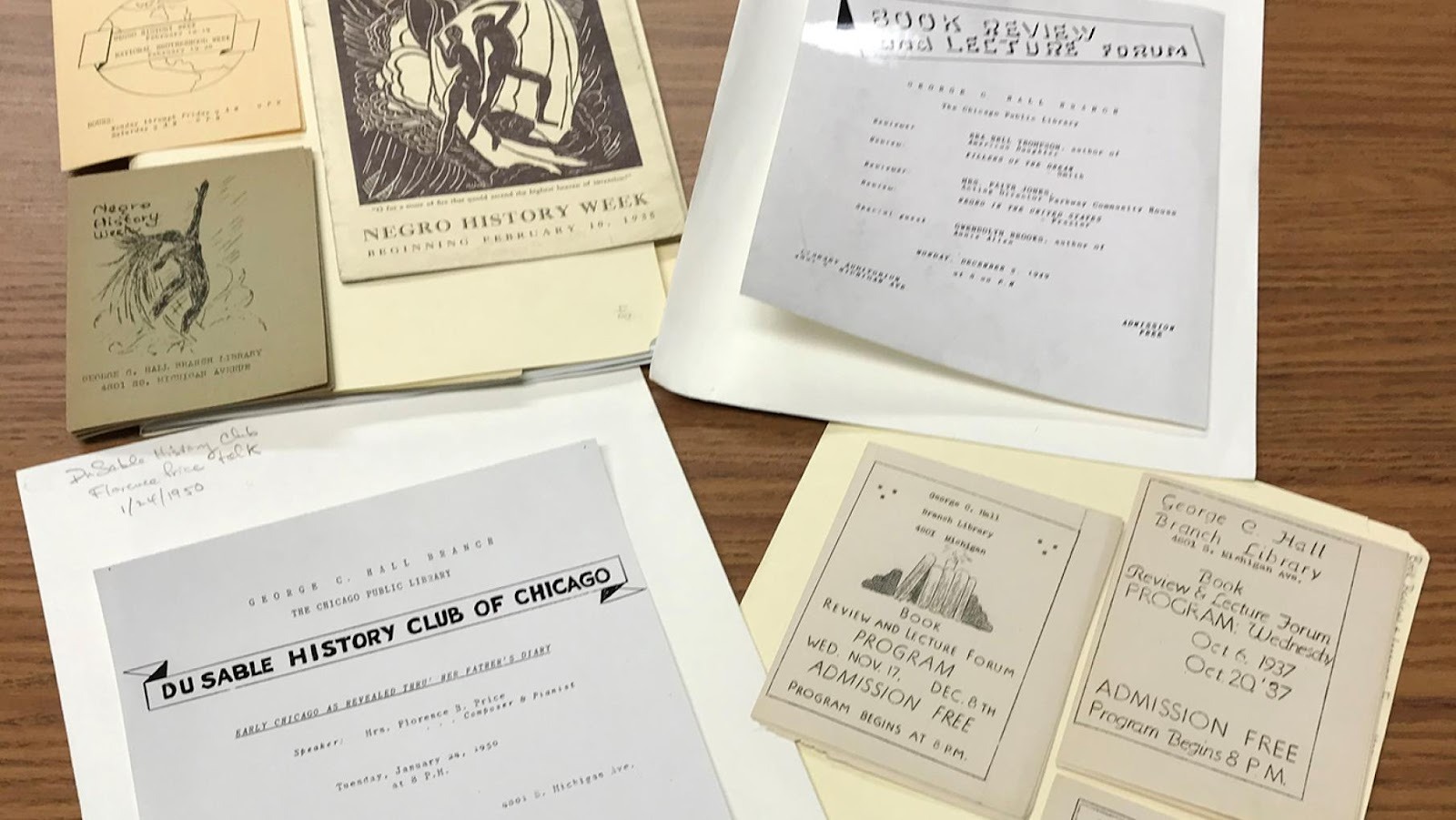
Harsh didn’t just manage a library; she built a living archive. She nurtured what became the Special Negro Collection, gathering books, manuscripts, church archives, and personal papers that documented Black life, creativity, and resistance. Her work attracted writers and thinkers like Gwendolyn Brooks, Zora Neale Hurston, Richard Wright, Alain Locke, and Langston Hughes—many of whom contributed directly to the collection. Langston Hughes even donated the manuscript of The Big Sea, complete with handwritten edits.
Harsh was also deeply connected to Carter G. Woodson. In 1915, Woodson met with Black leaders at the Wabash Avenue YMCA—including George Cleveland Hall—to help found ASALH. Harsh later became an active member, using her position to promote Negro History Week and host educational programs throughout her tenure.
The collection she built would eventually be named in her honor: The Vivian G. Harsh Research Collection of Afro-American History and Literature, now housed at the Carter G. Woodson Regional Library in Washington Heights. Today, it is the largest collection of its kind in the Midwest and continues to inspire new generations of scholars, writers, and organizers.

.png)
.png)