.png)
Chicago has always attempted to escape its bad rap. This is the story of Chicago rising from the ashes to the World's Columbian Exposition

Chicago has always attempted to escape its bad rap. As early as 1872, only a year following the Great Chicago Fire, the City was devising ways to change the narrative that Chicago was plainly the “Wild West”. The best way to do so by inviting the world to Chicago through what it did best, large-scale exhibitions. Some decades before McCormick sat on the southside of the city, the Interstate Industrial Building was the largest exposition building.
“The “Glass Palace” as it was known, was to show how much the city had recovered following the great fire. It was billed as “the largest structure ever built on the American continent” with 220,000 square feet of exhibit space.” - Chicago Cook County Cemeteries
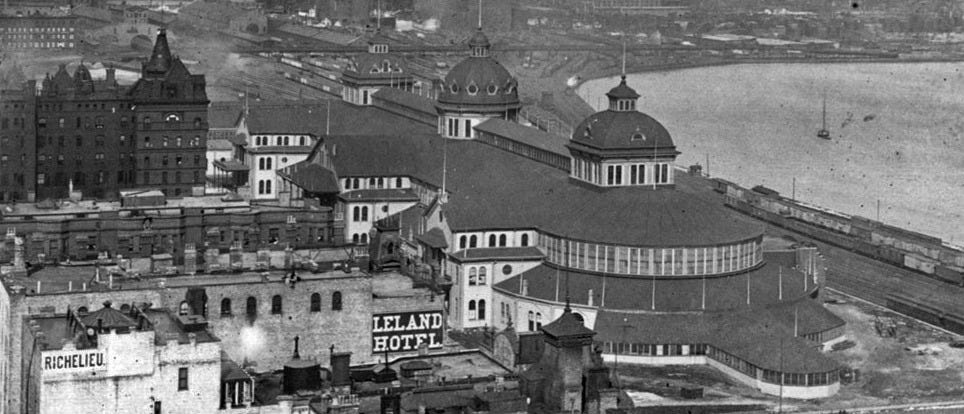
William W. Boyington completed the building in just 90 days, creating a space designed to showcase Chicago to the world. As the city approached the World’s Columbian Exposition of 1893, this structure was demolished and later replaced by the Art Institute of Chicago.
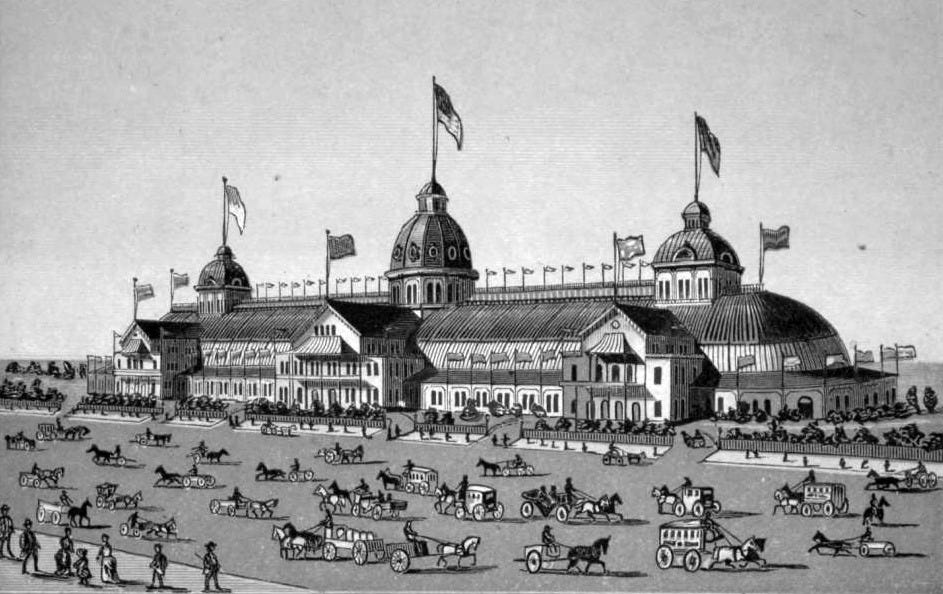
The Glass Palace was more than a building, it was a preview. Chicago was already rehearsing how to present itself to the world. By the late 1880s, that ambition would take on a much larger stage. This marked the beginning of Chicago’s push to host a monumental celebration: the 400th anniversary of Christopher Columbus’s “discovery” of the Americas. It’s important to note that historical accounts from this period use language that identifies Columbus as the discoverer, as that framing shaped the event itself. In recounting this history, I will reflect the terminology of the time, though it does not represent my own beliefs.
The true qualifier for the host of the World’s Columbian Exposition, from this point forward known as the Fair, was whether you could raise the money to pay for the expenses. By the time Chicago was lobbying for the bid in 1889, it had raised $5 million dollars of the projected $15 million cost. Four cities competed for the honor; St. Louis, Washington D.C., New York City, and Chicago. By October of 1889, NYC was projected to fall out of the race, St. Louis and D.C. stood no chance.
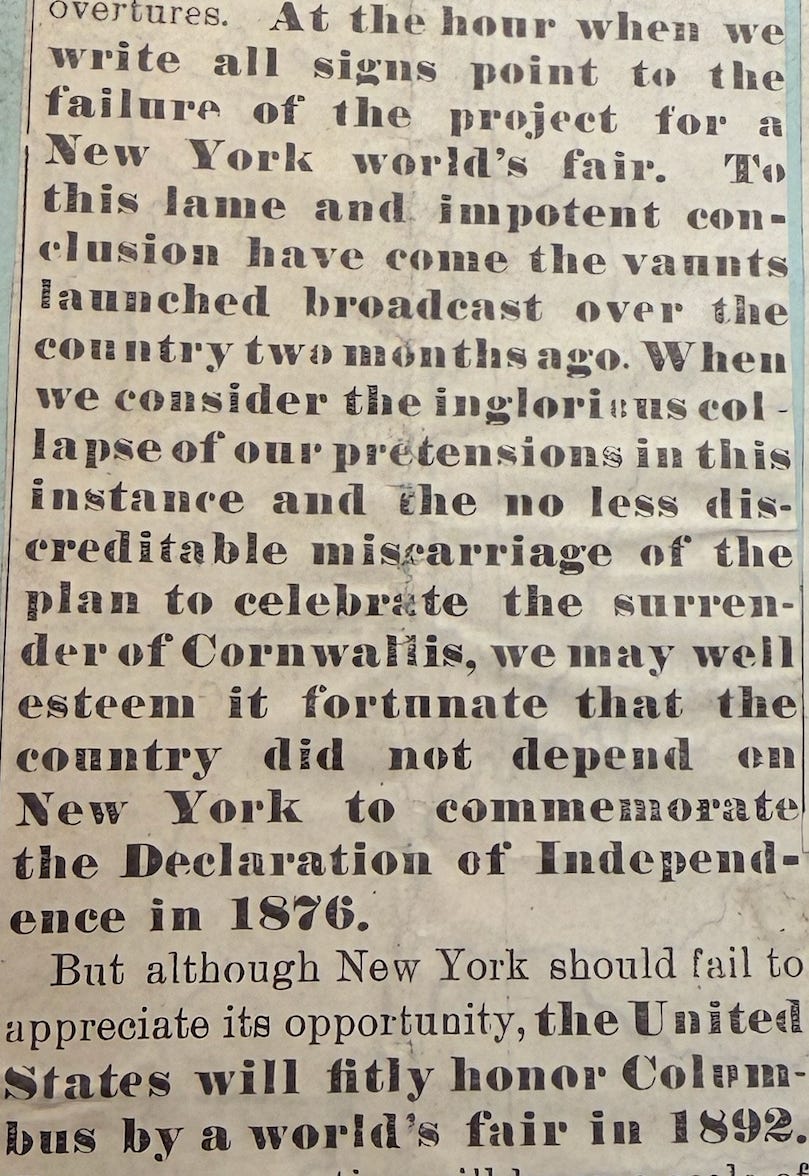
“The privilege of holding fairs in England is granted by the King. The privilege of holding the Columbian Fair in 1892 in Chicago can be granted by the Congress of the United States.” - Isaac H. Taylor, Editor of the Headquarters of the World’s Exposition of 1892
There were many reasons that Chicago was seen as the perfect city to host the Fair. Situated in the West, Chicago was much easier to get to than NYC. It had also spent the last two decades building up railroads and infrastructure to support a large visitor count. Following the fire and the multiple annexations of the late 19th century, much of its land remained open and undeveloped which allowed for vast open spaces to be built up. But ultimately, it was home to some of the richest men in the country, and they wanted to show off their city.
By 1890, there were 100 congressmen lobbying for Chicago to win. Representative Robert Hitt of Illinois, introduced a bill to the senate to back Chicago and by March of 1890, Senator David of Virginia had introduced a second bill to establish the Exposition of Chicago, it was passed and later approved by the president by April 25, 1890.
“An Act to provide for celebrating the 400th anniversary of the discovery of America by Christopher Columbus, by holding an International Exhibition of Arts, Industries, Manufactures, and product of the soil, mine and sea in the City of Chicago, in the State of Illinois.” World’s Columbian Exposition of 1893. Collection, [Box 6], Hanna Holborn Gray Special Collections Research Center, University of Chicago Library.
Once the Act passed, it was followed by very specific provisions…
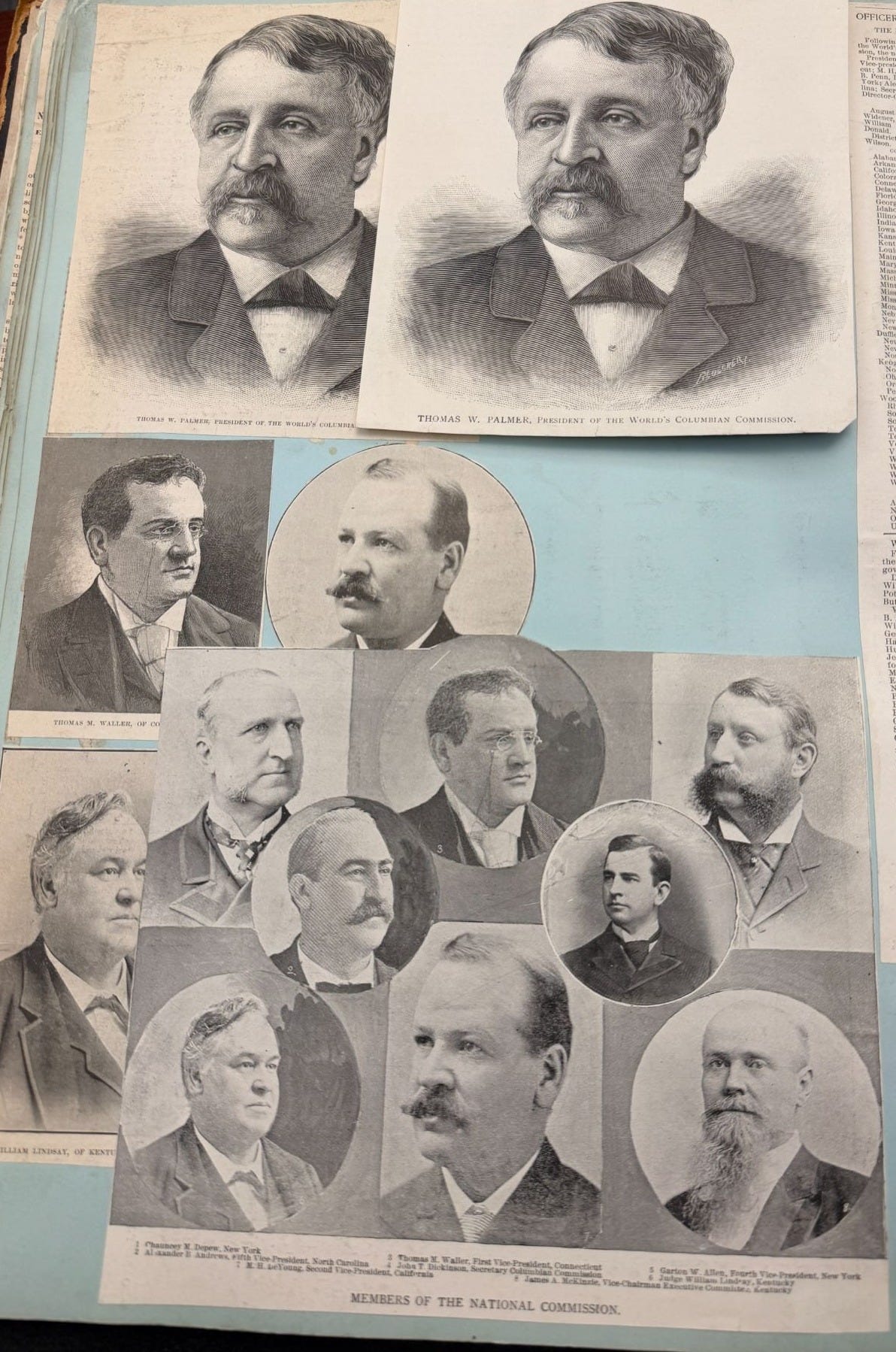
The commissioners were tasked with a handful of critical items. They were responsible for determining the scope of the Fair, assigning the exhibitors, preparing all the classifications that they would fall under. This included all foreign exhibitors.
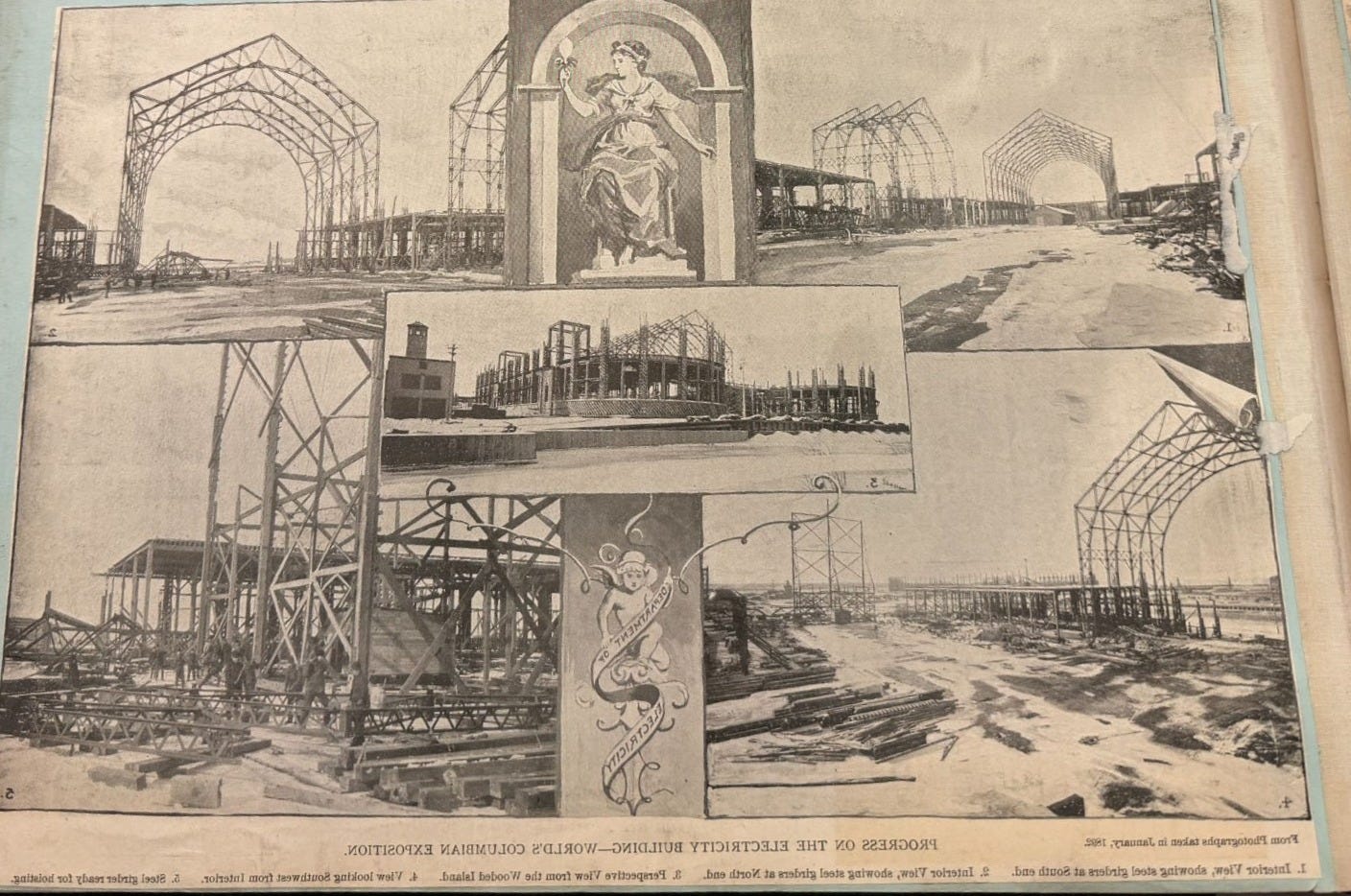
The Chicago Herald held a vote on June 18th 1890 to establish the location of the Fair. It was determined that it will be held in Jackson Park, Washington Park, part of Lake Michigan, and Lake Front Park, now Grant Park. The following 18 months were spent entirely resurfacing the area that was up to this point, marshy land. In that time frame, Jackson Park was raised 7-12 feet above Lake Michigan, lagoons and canals were built to allow for that image of the Fair we know so well. $4 million dollars worth of landscaping over 1037 acres was completed to accommodate the many structures and thousands of visitors.
During this time, each department building including fisheries, manufacturing, agriculture, and horticulture just to name a few, was underway and projected to be fully ready by October of 1892. Although the original “celebration” was meant for 1892, the Fair did not open until May of 1893.
The story of the Fair began long before the gates opened in 1893. It started with a city that once again, was determined to redefine herself. Chicago was rising from the ashes and the landscape was about to be reshaped. From the hurried construction of the “Glass Palace” to the political maneuvering in Washington, Chicago proved it could not only imagine something bigger, but execute it at an unprecedented scale.
The Fair was a statement to prove that Chicago was no longer the scrappy, fire-scarred city on the edge of the frontier. It was organized, industrial, visionary, and above all, ready to be seen. The groundwork laid in these early years set the stage for one of the most influential world’s fairs in history, and for Chicago’s emergence as a global city.
“Chicago will be the main exhibit at the Columbian Exposition of 1893. No matter what the aggregation of wonders there, no matter what the Eiffel-Tower-like chief exhibit may be, the city itself will make the most surprising presentation. Those who go to study the world’s progress will find no other result of human force so wonderful, extravagant, or peculiar. Those who carry with them the prejudices begotten of political rivalry or commercial envy will discover that, however well-founded some of the criticism has been especially as to the spirit of the Chicagoans, the development of the place has not followed the logical deductions. Those who go clear-minded, expecting to see a great city, will find one different from that which any precedent has led them to look for.” Harper’s Weekly (New York), “Building our Great Fair,” circa 1892. World’s Columbian Exposition of 1893. Collection, [Box 4, Folder 4], Hanna Holborn Gray Special Collections Research Center, University of Chicago Library.
Additional fiction list by World’s Fair Chicago

World’s Columbian Exposition of 1893. Collection, [Box 1,3,4,6,9,10], Hanna Holborn Gray Special Collections Research Center, University of Chicago Library.
“The nut shell”; the ideal pocket guide to the World’s Fair and what to see there ... Compiled by Stuart C. Wade ... and Walter S. Wrenn. Hanna Holborn Gray Special Collections Research Center, University of Chicago Library.
Chicago and Cook County Cemeteries
.png)