
Pack your proverbial bags and hand over your room key, we’re leaving the Expo.
If you’ve been around for a while, you might have heard, read, or seen me talk about my love for the World’s Fair and all its magnificence. Through it, Chicago became the city that we love so dearly, but I also have often discussed how nuanced moments in history can be. I’m not here to rain on your parade, but the Fair, like many other historically significant events in the 19th century, intentionally excluded Black Americans and any other group that wasn’t simply white.
A few weeks ago when we visited the Midway at the Fair, I mentioned how this was a place built specifically to showcase nations and groups that were considered ‘savage’. So it should be no surprise that the planners that approved that would also go on to not consider or include Black Americans in the planning, at the pavilions, or even at the Midway.
“At the World’s Columbian Exposition, African Americans stood as a people without a nation at a gathering of nations” Barbara J Ballard, A People without a Nation
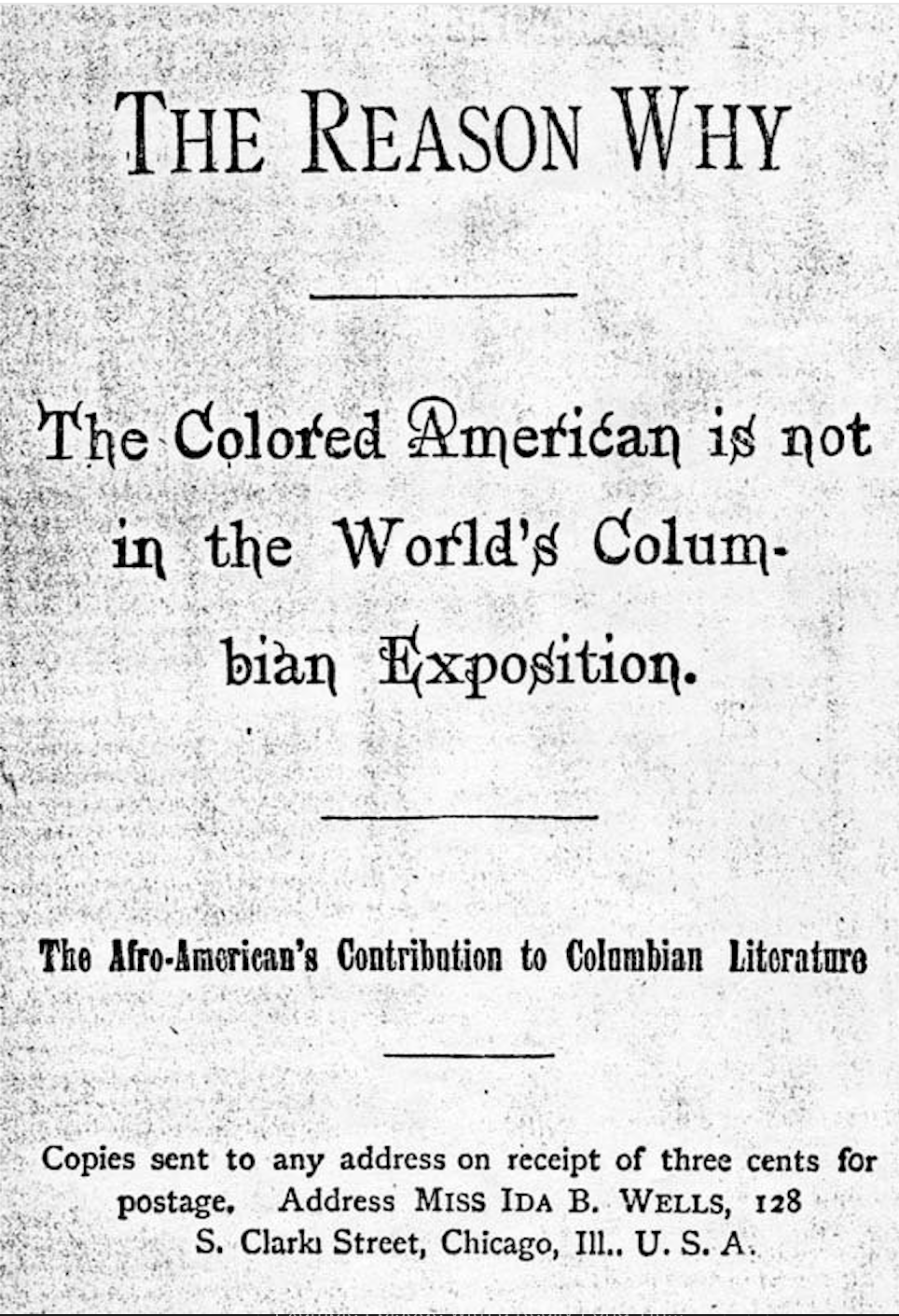
Ida B. Wells, Frederick Douglass, Ferdinand Barnett, and I. Garland Penn worked together to push for Black inclusion at the Fair. Time and again, their efforts were denied, and Black leaders were excluded from official ceremonies and positions of visibility. In response, the four collaborated on a pamphlet titled The Reason Why the Colored American Is Not in the World’s Columbian Exposition. The publication argued that the Fair presented a missed opportunity to showcase Black progress in education, business, politics, and property ownership in the decades following emancipation. It also directly confronted racist narratives that portrayed Black Americans as incapable of self-governance or advancement.
Black women faced exclusion as well. Despite the existence of the Women’s Building, Black women were largely shut out of meaningful participation. Leaders including Anna Julia Cooper, Fannie Barrier Williams, and Fannie Jackson Coppin used the speaking opportunities available to them to challenge inequality and advocate for Black achievement and recognition.
Meanwhile, the Haiti Pavilion emerged as the only official space at the Fair representing people of African descent. Haitian President Florvil Hyppolite opened that space to African American leaders, allowing it to become both a site of visibility and a platform for protest.
Behind closed doors, conversations continued around Black emigration, the future of Liberia, and arguments against extending civil rights to Black Americans. Douglass attended many of these discussions and remained unwavering in his rejection of those ideas, insisting instead that Black Americans belonged in the United States and had a rightful claim to citizenship. Though denied official recognition, Black Americans created their own spaces for representation, resistance, and political expression. In the end, the Fair was not only a showcase of progress. It was also a battle over who had the right to represent modernity, citizenship, and Chicago to the world.
History is rarely as simple as we want it to be. The World’s Fair gave Chicago many of the stories we still tell ourselves today. It reinforced the idea of Chicago as a world-class city, a place of innovation, ambition, architecture, and possibility. Those things can be true while it’s also true that the Fair excluded people whose labor, ideas, and lives helped shape that same city.
What stays with me most isn’t the exclusion itself, but the response to it. Black Americans didn’t quietly accept being written out of the story. They documented it. They protested it. They built their own spaces when official ones were denied to them. They stood in Haiti’s Pavilion, published pamphlets, gave speeches, and insisted on being seen even when the Fair refused to acknowledge them.
So as we leave the White City behind and hand over our room key, it’s worth remembering that history isn’t just shaped by the people who built the stages. It’s also shaped by the people who demanded a place on them.

.png)

.png)